Monday, 6 March 2017

Brainy Birds

This is my newest coloured pencil drawing which recently made its debut on line and also  at a local exhibition. I call it "Master Builders (Bushtits)".


Many who have seen it have been intrigued because the nest looks like something from a TV nature program about birds in some distant land. They had no idea there were such elaborate nests to be found right here in our local woodlands. But there are!

If you know what you're looking for it's not difficult to spot these sock-like constructions dangling among branches, particularly from late fall through early spring when there are no leaves to obscure the view. I observed and photographed this one (below), which served as the reference for my "Master Builders" drawing, at the Reifel Bird Sanctuary a couple of springs ago. At first glance it might look like just a hunk of moss but there's something artful about it that makes it more than just an accident of nature.


Even more intriguing is the fact that these intricate structures are built by one of the tiniest songbirds - plain-old ordinary bushtits which are often seen at birdfeeders. In particular, they have a fondness for suet cakes. The neighbourhood gang drops by regularly at my feeder to sample my offerings.


It's hard to imagine that these intrepid little creatures can, with just their beaks to work with, weave such large, magnificent homes. But they can! Guided only by instinct, they select the materials which they collect and transport to their building site, and then - one twig, one shred of moss, one strand of spider silk at a time - they create something amazing. Somehow they know exactly what to do and how to do it.

So the next time you see a flock of twittering bushtits consider their abilities and ponder the amount of energy and dedication it takes for them to construct their intricate nests. If you spot a nest during the spring when the birds are intent on building a home where they will brood their eggs and (providing everything goes according to plan) rear their babies, please observe from a distance. Bushtits can be put off by the presence of too much human activity nearby and can't afford to abandon construction and expend extra energy on another nest in a new location.

There are lessons to be learned in nature. Ordinary little bushtits are master builders who are pre-programmed with nest-building know-how, who have boundless perseverance, and who are undaunted by a seemingly insurmountable task.

Personally, I think they give the term "birdbrain" a whole new meaning.

Saturday, 4 February 2017

Trouble in paradise

I recently took out a membership with the Mayne Island Conservancy - a dedicated group with a mandate to protect the island's delicate habitat. They educate the public, they raise and sell native plants, they count birds - in general they encourage thoughtful stewardship of the land and sea. The organization is currently working to preserve an ecologically rich tract of waterfront which, if they are successful, will then be safeguarded from future development. I admire and support the work of individuals such as these committed volunteers who recognize the precious nature of island habitats.

Last month I was able to make a trip south to another island - this one in the middle of the Pacific Ocean.


It had been 20 years since I last visited Maui and I remembered it fondly. During this visit, as much as I enjoyed the sunshine and the beaches and the welcome break from winter, it served as a strong reminder about just how precarious island habitats are.

I saw and photographed lots of birds. I even had the good fortune to glimpse an owl (always a thrill). But of the many species I encountered, perilously few were native to the island. The cooing doves, kooky shrieking Frankolins (kind of like a partridge), the mobs of mynahs, the myriad twittering finches, charming lovebirds and stealthy egrets - all of them introduced from Asia, or Africa, or India, or other places with similar climates. Pets gone wild, game birds, or simply by human whim, these birds thrive.

Brazilian cardinal

Cattle egret

Lovebirds

Mynahs
 
Not so the native Hawai'ian birds. Dozens of species are gone, others hang on by only a thread. Habitat loss, aggressive introduced species (mongoose, feral cats and many others), and diseases to which the native birds had no immunity have taken a massive toll. The only native species I was able to observe were shorebirds, both migratory and year-round residents.
 
Black crowned night heron

Golden plover

Many find sanctuary in the Kealia Pond National Wildlife Refuge - a place not unlike the Reifel Bird Sanctuary back home.

Hawai'ian stilt


Hawai'ian coot

The island was a breadbasket after Western colonization, producing fruit, sugar cane, cattle and more. What were once productive cane fields are now fallow. There's not a pineapple in sight. Vast acres of former grazing lands are overgrown with an aggressive type of vine that was planted as fodder for cattle and now, without hungry mouths to keep it in check, spreads wildly and engulfs everything in its path in a thick green layer of choking foliage like something out of a sci-fi movie. Plants introduced in the interest of food production or simply for decoration thrive and run amok. Traces of the original habitat are long gone.

I found this visit to Hawai'i to be instructive. On one hand there are success stories - scores of sea turtles and plentiful humpback whales could be viewed from the shore at leisure.


And there are, of course, land areas that have been protected. The silversword plant, once virtually extinct due to overgrazing and found nowhere else in the world, has made a comeback at Haleakala National Park.

 
However, the losses are shocking. Dozens of the bird species who called the Hawai'ian Islands home - birds that were found nowhere else on earth - are now extinct, many during my own lifetime and some, like the po'ouli (a type of honeycreeper), since my last visit to the island. I hope the valiant efforts being made to preserve the remaining small populations of threatened bird species will work. It's a situation not unlike the Northern Spotted Owls I wrote about recently - one where human intervention and Herculean long-term conservation efforts offer the only hope.

Islands are microcosms for what's happening to our planet which is in itself an island in the Universe. We would do well to pay attention. Thankfully there are groups, such as the Mayne Island Conservancy, who already are.

Friday, 13 January 2017

Predator vs Alien

I love owls. I have kind of a thing for them. Seeing one always gives me a thrill, as I described in my very first blog post Day of the Owls some years back. I have photographed them whenever possible, I've drawn them, and I have plans for more artwork featuring them. 

Barred owl (coloured pencil)
Short-eared owl (coloured pencil)
Great horned owl (coloured pencil)

That's why when I heard that the Northern Spotted Owl Breeding Program was opening its doors to public visits, I jumped at the chance. I never expected I'd ever see one of these elusive birds. After all, in BC they are critically endangered to the point where there might be a dozen of them still existing in the wild, and to the south US populations are also under severe threat. 

This program's mission is to re-establish a viable wild population in BC by breeding owls in captivity, rearing and then releasing the offspring into protected habitat that's been set aside for them. It's slow going for a number of reasons, primarily that nobody ever tried to do this before so there's been a lot to learn. The staff, whose enthusiasm and level of commitment for their work is nothing short of awe-inspiring, are confident that the program will yield significant results soon. They've learned a lot over the past years of the program and with 17 of the precious birds on site, some of whom are now second generation, they're convinced that the steady production of releasable owl-lets can't be far off.
 
Spotted owls are medium-sized as owls go (smaller than I expected) with softly speckled brown plumage, deep dark eyes and a quiet demeanor. As visitors, we were allowed to see and photograph this handsome retiree from the breeding program.
 
 
I once read that the haunting calls of spotted owls could bring tears to the eyes of the Europeans who first visited our western forests. These birds are are shy, reclusive, and have very specific needs that can be met only among old growth trees - that is, forests more than 150 years old. They require big dead trees to provide nest cavities, their diet consists primarily of northern flying squirrels, and they require large territories in which to make their living. They are specialized denizens of the deep woods.

However, deforestation is only one of the primary threats to these owls' existence. Despite thousands of protected acres allocated as owl habitat in southwestern BC, their numbers continue to decline. A big problem is this alien invader:

 
I admit that I love barred owls (even after watching this one rip a thankfully-already-dead mouse to pieces). I hear them hooting softly in the trees at night and they're the species I see most often. But there's a reason for that: they are opportunists who eat anything they can catch, breed readily, and are basically great at adapting to whatever circumstances come their way. They have gradually spread across the continent, taking advantage of human development, and have over-run what used to be northern spotted owl territory. They look a bit like spotted owls but they're bigger and far more aggressive. They are an invasive species that the spotted owls cannot combat and their take-over is almost complete.
 
Without human intervention, the northern spotted owl will disappear from our forests forever. Barred owls are now captured when they invade spotted owl territories and are moved elsewhere. The tiny population of aging wild northern spotted owls will (fingers crossed) soon be bolstered by the release of captive-bred youngsters.

There is hope we won't lose this shy predator to the alien occupation - the first wave being the humans who cut down most of their forests, followed by the interloping barred owls who arrived in our wake and stole what remained. It's ironic that it's now up to us to save them.

To find out more about the Northern Spotted Owl Breeding Program visit their Facebook Page: https://www.facebook.com/nsobreedingprogram/?hc_ref=SEARCH&fref=nf

Saturday, 7 January 2017

West coast winter wonders

The waning days of the old year are often a hurried time of excitement and excess. For me, they provided a time to slow down and appreciate the quiet wonder of this part of the world. I had my own rush of activity as I wrapped up workshops and commissioned artworks with Christmas delivery dates, this coloured pencil drawing of a warbler among them:


I then slipped away from the frigid mainland into the embrace of that most wonderful of places: the west coast of Vancouver Island. A funky beach-front house, open stretches of sand, and glorious vistas of surf and shoreline were mine to enjoy, with the good company of my sister and her family, for a blissful week of long walks and awe-inspiring moments when the beauty of the place simply becomes too much for words.


As always, the local wildlife provided picture-perfect moments:


And a certain small black cocker spaniel simply couldn't get enough time on the beach chasing her beloved ball!


Over the course of a week, weather conditions ran the gamut. Sub-zero temperatures on arrival were blown away by a frantic gale with 100km-per-hour winds, making beach walking a challenge! Rising temperatures brought gentle rain after which the clouds cleared to reveal the glorious winter sun. There were moments when sitting on the deck in the sunshine with a cup of tea was the best thing in the world; a rare mid-winter treat. 


At nightfall, Venus could be observed shining brightly and stars twinkled with a clarity that can only be observed in places remote from city lights. My sleeping quarters were a glass-roofed solarium and one morning I awoke to a gift: the sight of a bald eagle soaring above me against the backdrop of clear blue sky. That image will stay with me forever without the aid of a photograph. 


This winter on the west coast is truly a time of quiet wonders, abundant gifts that don't come from any store.

Saturday, 26 November 2016

Bright sparks on grey days

Autumn in southwestern BC is often rainy - an understatement to those who live here. Last month saw only three dry days and broke rainy-day weather records set in the 1960s. This month appears to be bent on continuing the trend. In addition, the hours of light each day are short and getting shorter as the winter solstice is still weeks away. When thick rainclouds obscure the sun (which we know has to be up there somewhere for a few brief hours each day) it can feel like living in perpetual twilight. It is, in a word, gloomy.

I'm one of those people who loves the sun and I'm happiest mid-summer when bright hours start early and stretch well into the evening. When it's grey and wet for days on end I can also become, in a word, gloomy.
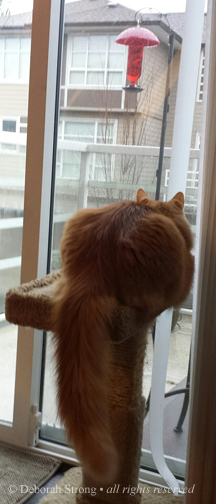
However, brightening my days are, as always, the creatures around me. I recently erected a suet feeder outside my studio and I immediately realized what I had been missing in the months since my move. Chickadees have naturally assumed ownership - both black-capped and chestnut-sided varieties. A couple of chestnut-sideds are my most regular visitors:


A chestnut sided chickadee samples my suet feeder that's
designed to discourage rodents.
Chestnut chickadee number two waits nearby. Rarely do both
feed at once. One is always keeping watch for danger.

Flocks of tiny, twittering bush-tits descend in their multitudes to feed and flutter briefly before carrying on in a rush of feathers to their next stop:


Bush-tit feeding frenzy.

There are also more solitary species: sparrows, downy woodpeckers and juncos:

A dark-eyed junco waits in the adjacent magnolia tree.

Most profoundly delightful for me are a duo of little ruby-crowned kinglets - a species of tiny songbird I haven't seen since I was a child:


A tiny ruby-crowned kinglet displays a hint of the crimson streak for
which it earned its name - a streak that transforms into a bright flash
of colour when the timing's right.

With the suet feeder success under my belt, I decided to see what other birds I could entice. On my second floor balcony just outside my kitchen I installed a hummingbird feeder. It might seem like an odd thing to do as winter approaches but I had been observing a number of Anna's hummingbirds in the area - a variety that often over-winters in this part of Canada - and was hopeful they might appreciate another feeding station in the neighbourhood.


No more than five minutes after hanging the feeder, the first sampler arrived:


The taste-test must have earned approval because since then there is always a hummer or two or three hanging about. My daily delight is observing them from my breakfast table. As an added bonus, I have come to realize that the tuft of moss revealed when the leaves fell from an adjacent maple tree isn't just a tuft of moss. It's a tiny nest!


Thankfully the dreary days of raincoats, and rubber boots, and dog towels piled by the door have been made easier to bear by tiny feathered sparks of energy just outside the windows. Who could fail to be cheered by the comings and goings of these small, lively creatures?

Housecat Hugo is certainly enjoying the show.


His hours of entertainment are even extended into the evening, thanks to nature programs on public television.

 
How many more days till spring?

Thursday, 27 October 2016

Where's Archie?

Since Hugo posted about his vacation a while ago, several of my readers have cautiously enquired as to the whereabouts of Archie (aka The cat who could fly). They've expressed concern that some cat-astrophe had befallen my gentle grey giant.

A portrait of Archie I completed a few years ago.


Let me reassure you that Archie is fine. In fact, Archie is more than fine - he's  tremendous! He's no longer at the bottom of the canine/feline pecking order around here and is now king of his own castle with three doting human slaves. Archie basically packed his little kitty-cat bags and moved out!

Well... it didn't exactly happen quite that way. A few months ago when I was in the throes of selling my house, the critters (Lily, Hugo and Archie) and I moved in with some friends to ensure my house remained pristine and pet-hair-free while it was being shown to potential buyers. My friends had recently lost their own two cats - geriatric brothers - to age related illnesses that struck them down within weeks of one another. Bereft and for the first time cat-less, they welcomed us into their home even if it did mean making room for a lively cocker spaniel in addition to me and the two felines.

To make a long story short, a love story developed between them and Archie. As our stay drew to a close, they cautiously asked if I'd consider letting them give him a permanent home. I needed a bit of time to mull it over - after all, when an animal joins my family, it's for life - so I agreed to a temporary trial period. However, I knew in my heart Archie was not thriving with me. Despite my best efforts at behaviour management, his reserved, cautious nature and skittishness meant he was often ill at ease as the boisterous puppy and kitten duo of Lily and Hugo grew into rambunctious young adults. This situation would not improve in the new, much smaller home that we would be moving to.

A playful wrestling match between Lily and Hugo

Lily always teased Archie unmercifully. As for Hugo... well... here's a picture:


So ultimately I realized the opportunity for a loving new home would be in Archie's best interests. My friends would have a cat in their lives once again, and Archie would be the solo centre of attention. Happily for me, I'd be able to visit regularly.

It didn't take long to see that Archie was thrilled with the arrangement. Although I suspect he initially missed his little buddy Hugo (and I know Hugo missed him), time passed and we all adapted.

HRH Archie on his new throne.

So now dear Archie permanently resides with my friends. He rules his new kingdom with a gentle paw, accepting (and now expecting) daily brushings, dining on gourmet food that can be nibbled at leisure rather than gobbled lest some other animal claim it, and accepting frequent caresses from his humans. He's even come out of his shell and become much more social, just as he was as a younger cat. I visit regularly and he always appears glad to see me although not so much his former nemesis, my side-kick Lily.

He has new places to nap:


And fun things to occupy his time:

 
And can relax completely, blissfully without fear of being leapt on by an exuberant young housemate!
 

He's even made a new friend:


And as for life at home, Lily and Hugo appear to be quite content with one another's company.

May we all live happily ever after.