Wednesday, 21 November 2012

Water, Water Everywhere...

Where does the time go?! It's been several weeks since my last blog entry but given the weather here recently, I wouldn't be surprised if large chunks of time have simply been washed away. The west coast of Canada isn't known as the "wet" coast for nothing! It's been raining... and raining... and raining... and the days have become short, and dark, and it is, in a word, gloomy. It's a tough time of year for those of us who yearn for sunshine, or at least yearn not to be forced into rubber boots and raincoats for every trip outdoors. Even my dog is not amused as I wrap her once more in her own rubberized jacket before heading out for our daily walk (it's really for my own convenience because it saves me having a soggy dog lying about the house).

Usually my studio offers a brightly-lit haven where I can cocoon myself away from the darkest days of the outside world. However my current art project has involved some research that's had an anything but positive impact on my dreary state of mind. I'm wrapping up a series of illustrations for a children's book called "Living Water" based on a poem by Jean Ranola-Collier. It's an ode to the importance of cherishing and preserving the Earth's water supply - a precious resource that many people take for granted, particularly those who live in a place where a seemingly endless amount of it cascades relentlessly from the sky for days on end.

I've been working on the project since summer, designing and executing each illustration using dyes on silk. Back when the sun was shining these were the some of the images I was producing:

A healthy ocean ecosystem teeming with colourful sea life.

 
A vibrant, fresh water environment that people can enjoy.
 
But now, during the dark days of November, I have had to delve into some pretty grim research. Descriptions of the unbelievable amounts of garbage and pollution that jeopardize life on Earth have invaded my psyche. I've absorbed stories of communities decimated by lethal toxins in their drinking water. I'm harbouring images of seabirds and turtles poisoned by swallowing plastic or drowned entangled in cast-off nets and fishing line, and of other pathetic creatures coated in thick, deadly crude oil. I've viewed barren ocean floors strewn with trash and nearly devoid of life, polluted rivers where fish float belly-up, and heroic armies of people struggling to clean up vast messes, one piece of garbage - mostly Styrofoam and plastic - at a time. It's tough stuff.

And so these are some the images I've produced recently:


A sea turtle swims in a barren ocean among floating plastic bags and garbage
 
 
A belching factory flanked by ghostly trees feeds a polluted river.

As troubling as the journey of creating some of these images has been, I'm glad to have worked on this project. I have produced a total of ten illustrations and have been challenged to expand the boundaries of my artistic comfort zone and tackle what are, for me, unusual subjects. As those of you who are familiar with my art will know, I rarely depict the human form. However this project led me to produce this:
 
 
Spurring me on is the belief that it's never too soon to raise awareness in children that the candy wrappers and plastic bottles and Styrofoam containers they might carelessly throw away could end up littering a beach or stuck in some animal's gullet, and that we're all responsible for the health of our planet whose life-blood is its water supply. We have a duty to demand that the manufacturers of the products we use are employing sound environmental practises, and that we not turn a blind eye when it comes to the makers of the goods we import from countries across the globe. The glimmer of hope that I'm creating something meaningful helps keep the numbing greyness of November at bay.

And to further lift my spirits, the little flower "garden" of house plants I keep in my kitchen window has chosen this dismal time of year to share the beauty of their blossoms. They need only to be watered regularly to generate this cheerful display. Just like "Living Water" tells us, without water they cannot flourish and would surely die.


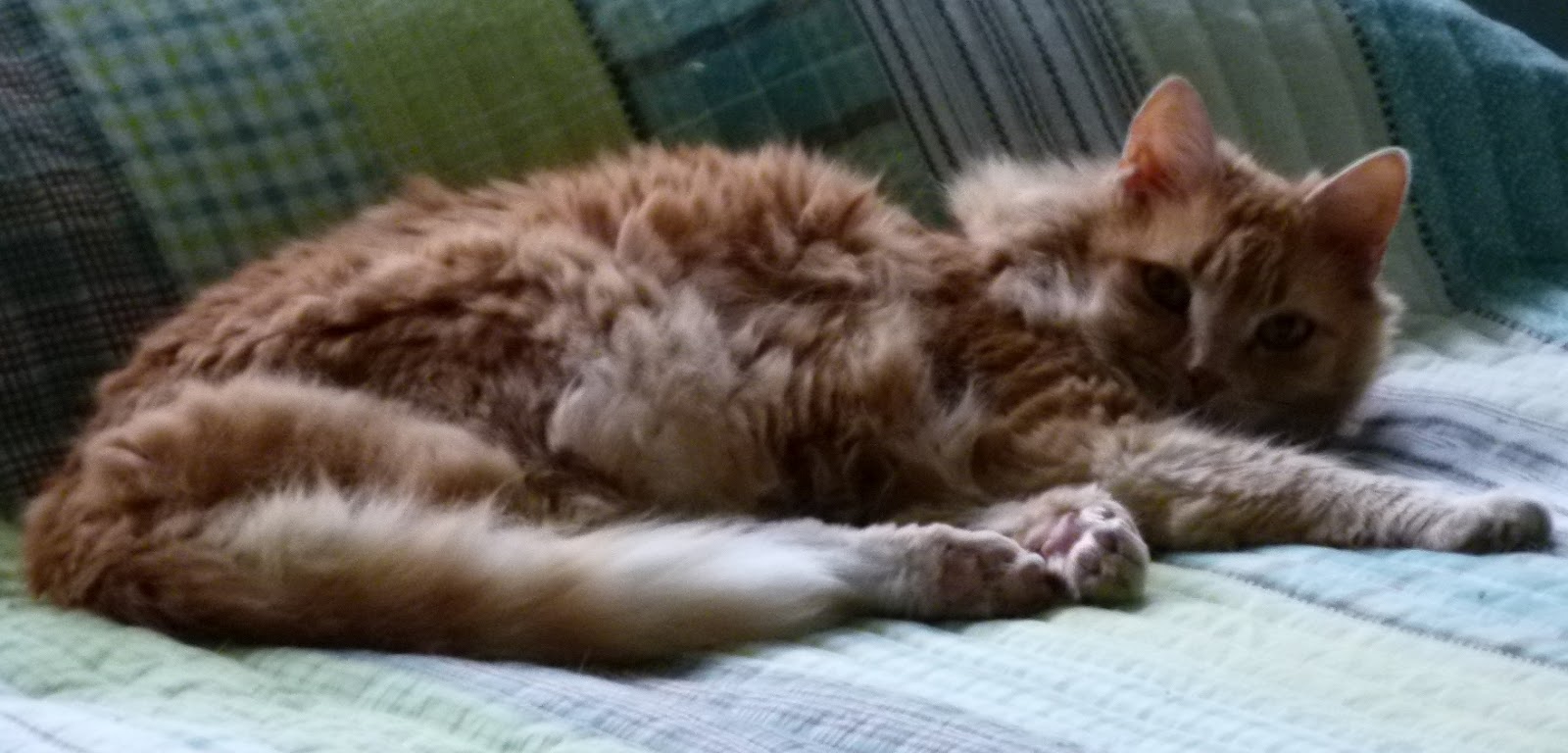
Not only do I appreciate the gift of this colourful display, but my old cat Rupert appears to do so as well.

 
Only 118 more days till spring.
 
If you're interested in knowing more about the children's book Living Water, stay tuned to my blog and/or website where updates will be posted as to the publication date (some time in 2013).
 
Note that all images are protected by copyright and may not be used without permission.

Friday, 26 October 2012

Gone to the Dogs

I have once again taken my art on the road and this time my mobile gallery is on site at the largest dog show in Canada! The "Travel the World" dog show takes place at the Abbotsford Tradex every October thanks to the efforts of the Lower Mainland Dog Fanciers. For four days the Tradex becomes a hub of canine activity, with daily competitions, demonstrations and a trade show of products and services for the discerning dog owner. Pet dogs are not allowed to attend, but there are competing and performing dogs in abundance: enormous, tiny and in-between sized, long haired, short haired, silky, coarse and curly coated, runners, diggers, hunters, herders, guarders, athletes, lap sitters and sofa snugglers, all under one roof. I'm displaying a range of my artwork, from lifelike coloured-pencil portraits, to lively silk paintings, plus a selection of silk scarves like the one pictured above that playfully celebrates the diversity of the dog world.  

My silk painting of a frolicking boxer, "Having a Ball at the Beach"

It goes without saying that an event like this provides dog watching opportunities second to none. I have seen sleek Salukis slinking past my booth, and toy like Coton de Tulears (a breed with which I was previously unfamiliar) with their snow-white powder-puff coats, not to mention a Newfoundland dog the size of a pony who strode past in a stately fashion. On one trip to the coffee stand I caught sight of a graceful Afghan hound shimmering like a mirage with its coat of long, gossamer hair, and later I glimpsed what I think was a puli, a stocky little herding dog whose mop-like coat resembles Rastafarian dreadlocks. And of course there are my personal favourites: the collies. I almost walked into a post gawking at a stunning blue merle male headed for the show ring, and had the infinite pleasure of meeting a young female smooth collie (the same breed as my own Riley only with a short coat) who is in training to be a service dog.


My booth couldn't be better situated for entertainment, with a great view of an arena where dogs are performing for show visitors. I have seen dancing dogs, obedient dogs, dogs who could jump really high and others who spin, or roll over repeatedly, or slink along on their bellies on command. Some have pulled carts, some have found their way through wooden "tunnels" in search of mechanical rats, others have clambered over obstacles, and still others have simply romped around and demonstrated their good natured, playful personalities. In the "Meet the Breed" area which surrounds this ring there are plucky representatives of Scotland's terrier clans, lumbering mastiffs whose wagging tails can pack a mighty wallop, a Portugese water dog who is inseparable from the stuffed toy he totes around, and even whippets wearing fleece pyjamas, all acting as ambassadors of their respective breeds and welcoming visitors to learn more about them. Their owners aren't shy about talking about them, and their eyes light up as they describe their dogs quirks, strengths and sometimes less-desirable qualities so that anyone interested in obtaining such a dog will know what both the pleasures and pitfalls of the breed can be.

The one thing every dog has in common is the obvious joy they bring to their humans. I have heard many stories of love, loyalty and faithful companionship, from tales of ageing dachshunds to proud boastings about newly-arrived Bichon Frise puppies. The stories are told with a smile that is sometimes wistful when a departed friend is the topic, but a smile nonetheless. These canines are family. And in the way of modern families, many owners whose dogs are waiting for them at home carry their precious pups' photos on their smartphones, so I've been able to not only hear their stories but see their pictures too!

I've used my time here, when I'm not chatting with visitors, to complete this coloured-pencil portrait of my Riley (aka the Collie Princess). It's been a fine way to not only show off my own wonderful dog but she's also provided a lovely subject with which to demonstrate my skills.

 
In a couple of more days it will all be over. The champions will have been awarded their ribbons and all will head home with their humans to await the next competition. And I'll be packing up my pencils and paintings, and heading back to the studio with visions of dogs of all shapes and sizes dancing in my head.

Monday, 15 October 2012

A History of Horses

A silk scarf in process on my work table.
Things are busy in the studio these days as I gear up to display and promote my art at a favourite annual show: The Mane Event. It's a kind of a trade show for the equestrian crowd and it draws folks from all over the region to see horse trainers in action, view horsey products, learn about horsey services, and basically immerse themselves full-on in a three day equine extravaganza. It's an event I always enjoy, despite long hours and a lengthy drive to and fro, because it connects me with a great crowd of outdoorsey people who are passionate about the critters - the horses, dogs, donkeys, sheep, llamas, cats, cattle, and whatever-else-have-you - that share their lives.

I don't have a horse in my own life right now but they're in my blood and therefore they surface regularly in my art. Looking back on my own history with horses, I recall there were always ponies or horses around our small farm during my childhood in Langley, BC. Many passed through our gates (my dad bought and sold livestock) but there were only four that I considered to be "mine".

The first, when I was four or five, was a cute-as-a-button Shetland pony named Tony who had the nasty habit of stopping suddenly and lowering his head in an effort to unseat me. If all went according to his plan, I'd tumble off and land in front of him so he could step on me (I can clearly recall having a Shetland-sized hoof print on my arm). It wasn't a love story between us but I was undeterred and Tony was followed by Dixie, a plump Welsh-x pony on whom I really learned to ride - or at least to stay in the saddle and steer effectively. There were no formal lessons, only a second-hand saddle and mis-matched bridle, a will to learn, and a good-natured pony who was gracious enough, most of the time, to put up with me. After a time and only a few mishaps that left me in the dust, the spunky little mare lost favour in our family by bolting out the front gate and leading us a merry chase down a nearby highway, my dad and I in hot pursuit in our Volkswagen Beetle. Thankfully she came to a stop unharmed on the lawn of a home that housed a very large family, and all the children of various ages and sizes were ushered out to form a human corral and capture her.

Dixie
As I had nearly outgrown Dixie anyway, she was soon sold and Apple arrived. Apple was, as the name suggests, an Appaloosa; a beautiful mare not much bigger than a pony. She came to us in horribly emaciated condition, and we were shocked to discover that she was in foal, producing a beautiful filly in fairly short order and blossoming into a nurturing mother. However poor Apple had a history of abuse and was so skittish my parents feared for my life when I rode her. She would spook at nothing and run hell-bent-for-leather away from whatever imaginary threat had frightened her, with me possibly in the saddle or quite likely in a heap on the ground. She never lost this alarming habit and it was not the best situation for my health or my parents' who were riddled with anxiety at the prospect that I'd eventually come to serious grief.

Duke
Then came Duke - my first full-sized horse and, as my friends, family and followers know, the equine love of my life. He was a young gelding who had landed in the hands of a local horse-trader. A gangley, butter-coloured palomino Saddlebred-Quarterhorse with a gentle, unflappable disposition, he was less than three years of age. He had been "green broke", meaning he'd had a rider on his back and some basic training, and he turned out to be the perfect match for a shy teenager with minimal riding skills but a fierce passion for horses. We learned together with the help of an older, experienced riding buddy, various books, and endless hours in the saddle. We were inseparable - if I could find time to ride for 15 minutes after school and before my babysitting job, I would. I brushed Duke, bathed him, braided his mane and tail, and rode and rode and rode. He wasn't a champion or a purebred, but he was a good boy - faithful, steady and true, good-natured and patient. We entered a few local horse shows and won a handful of ribbons but my passion really was just spending time with him and riding - miles and miles and miles of riding. No indoor arena for us, just the lure of the open road!

Duke and I covered a lot of territory together. During the 1970s you could have seen us heading out in various directions in the Aldergrove area: north to the vast acreage owned by the Department of National Defence and which in those days was open to riders, south to the trails of Aldergrove Lake Park (the man-made lake has since been drained and filled in, so it's now called Aldergrove Park), or making the long trek west to the equestrian heaven of Campbell Valley Park with its fine facilities and trails tailored to horseback riders. When I left home and the family farm was sold, Duke lived at other farms and stables in various parts of the Lower Mainland as I gypsied from place to place. In the 1980s, you might have seen us galloping around Mud Bay near Crescent Beach, or ambling around the Queensborough area that's now totally developed into housing and highways (in those days a horse and rider was an anomaly in an increasingly urbanized area, and we attracted lots of gawkers) or racing down the horse trail between Highway 1 and Burnaby Lake. In the 90s we both ended up back in Langley, and it was there Duke eventually ended his days at a small family-run stable just a stone's throw from our favourite place, Campbell Valley Park, which was where you'd have been most likely to have seen us during those last years. I remember our first ride in the park after moving back to Langley - Duke's joy was tangible (as was mine) as we returned to the stomping ground we'd left behind so many years earlier. There's now a plaque in the park's Spirit of the Horse Garden celebrating his memory.


So while I'm horseless these days, much of my past was spent in the saddle and I have the bad knees to prove it! Not to mention a couple of old saddles and a trunk full of tack gathering dust. Life has taken me in different directions and my art has followed suit, but the hours spent grooming, riding and observing horses are indelibly imprinted on me and I'm certain that even blindfolded I could make a fair stab at accurately drawing a horse. Pretty well the first thing I ever drew was a horse, and it may well be my last. My deep seated love for horses and for making art are forever intertwined.


"Friendly Faces" - my most recent equine artwork.

I don't know when a new horse will come along and become "mine" but I know one day, when circumstances are right, it will happen. For now I content myself with hanging out at places like the Mane Event and enjoying every moment of it.


Monday, 8 October 2012

Immersed in Colour

I have always believed that life-long learning is important to personal and professional development. To that end, each year I try to take at least one course or workshop on a topic that interests me and has practical applications to my life as an artist. This year I was pleased to enrol in the Maiwa Colour Institute, a five-day immersion in the world of colour that's part of the Maiwa Textile Symposium. Maiwa is a company based on Granville Island in Vancouver and is a hub for all things textile, from supplies to garments and much more. Each fall they organize a symposium of workshops, lectures and other related events. The annual Colour Institute led by Michelle Whipplinger is always a sell-out, filling quickly once registration commences, and I had the good fortune to be quick to enrol (in past years I had missed out). I was delighted to share the experience with an enthusiastic group of participants from Canada, the US and as far away as England.

I'm no stranger to colour, given my work as both a visual artist and graphic designer. However my formal training is further in my past than I care to admit and I felt I could benefit from a week of immersion in the topic of colour. And thus for five days straight my life was devoted to better understanding that very thing that is fundamental to my work as an artist. After a couple of days, words like hue, value, chroma, shade, tone, intensity and saturation were swimming in my head, along with visions of colour charts, colour wheels and colour swatches. When I closed my eyes I saw a kaleidoscope of every hue of the proverbial rainbow. When I walked down the street, the bright autumn leaves took on new meaning, speaking the language of colour in a way I hadn't interpreted before.

Every evening after the workshop (and after my arduous commute home from the city) I worked to apply the things I learned to my own work. On my art table was a drawing I had commenced a week or so earlier - a nuthatch that I had observed and photographed outside my studio window last winter. These lively blue-grey and buff coloured birds present a delightful subject in terms of both form, habits and colouring. I continued working on the drawing, filling in the background with colours I would not previously have considered, working with hues of greens, blues, red-violet and burnt orange.

The nuthatch bathed in a lively compliment of colours.

The drawing then served as my inspiration for the final project of the week. In combination with colourful found objects such as autumn leaves and a magazine cover, I devised a pattern based on the shape and energy of the little bird, and then experimented with colour combinations to better understand their relationship and effect on one another.

My collection of items that served as inspiration for my final project.
My final project.

With the workshop a few days behind me, I now find myself analyzing nature's colour schemes in terms of how each colour relates to another, and the effect they have (or don't have) upon one another in their various combinations. It's as though way I perceive the world has been altered in a fundamental way. The fall timing of the workshop could not have been better as the brilliant fall colours we're experiencing at the moment offer exciting fodder for thoughts about colour.

I look forward to seeing where my invigorated perceptions of colour will lead me as I move ever-forward on my artistic journey.

Sunday, 23 September 2012

A Nutty Experience

After a busy day at my studio, greeting the visitors dropping by for the Langley Art Studio Tour, my husband and I decided to take Riley (a.k.a. the collie princess) and head to Campbell Valley Park for a relaxing evening walk around a favourite trail known as the Little River Loop. This picturesque two-kilometre trail winds through woodlands and meadows, and across the boardwalks and bridges spanning the Little Campbell River and associated wetland. The immediate area is alive with birds, particularly chickadees, as well as a healthy population of squirrels - both the native red squirrels, European grey (and black) squirrels, plus the occasional chipmunk. Most are freeloaders, taking full advantage of the generosity of human visitors bearing gifts of seed and peanuts. The chickadees will even perch on willing hands when sunflower seeds are offered.

A trio of native red squirrels gobbling seed on the boardwalk.

Cute as a button, a red squirrel poses for my camera.

Riley observing a park denizen.

Today, as we neared the end of our walk, a strange thing happened. A small grey squirrel - a juvenile - came racing up to us. But unlike most park squirrels, it didn't pause a safe distance away to see if we'd toss a peanut, it ran right up to Riley (much to her excitement) then under her, only to arrive at my feet and then climb up my leg like a tree. It kept going till it reached my shoulder where it perched for a while before heading for my pocket. I didn't quite know what to do! The wee thing seemed to be in search of food so I fished out a Charlie Bear (a thumbnail-sized, cheese-flavoured dog treat). It was happily accepted and the fuzzy little rodent crept into the crook of my arm to enjoy the snack. When it was finished, I put the squirrel on the ground and attempted part ways but it then headed straight for my husband's leg and began to again ascend skyward. Not being quite the squirrel lover I am, he didn't enjoy this experience so I grabbed the squirrel, placed it back into the crook of my arm and offered it another Charlie Bear. It was content.


By this time, passers by were marvelling at this unusual squirrel behaviour. General consensus was it must have been hand-reared by some well meaning human who then left it in the park to fend for itself (it nipped me twice, so perhaps had outworn its welcome with its foster humans). Whatever the case, the little thing had absolutely no life skills other than figuring humans were the ticket to shelter and food. Being the softie I am, there was no way I could leave it in the cold, dark park to be killed by the first predator or less amenable dog that happened along, so I stuffed the squirrel into my camera bag, we headed to the car and then made a bee line for the Critter Care Wildlife Shelter.

Critter Care is located just a few kilometers away on the other side of the park. We had our fingers crossed there would be someone on site that late in the day willing to accept the little foundling. Happily a few personnel were still there, and though they wearily me advised me that I should probably have left the squirrel where I found it, they took pity and whisked my camera bag, complete with squirrel, into a back room. They had me sign a form and said they'd keep the youngster for observation (they determined that the squirrel was indeed a girl, and that she was a bit undersized to be out on her own) then they'd release her, ideally in a more appropriate location where proper wild squirrel behaviour could be learned. As I departed, the young woman who had assisted me said, "thank you for caring". The folks at Critter Care are good people who are very committed to the welfare of the animals who come their way, even a physically healthy but behaviourally inept young squirrel.

Today I'm hoping Nutkin, as I casually named her in honour of my childhood favourite author/illustrator Beatrix Potter, is safe at the shelter and that the Critter Care staff and volunteers will do their best to ensure her needs are met. A word to the wise: if you find a baby squirrel, please don't take it home and try to raise it as a pet and then later abandon it when it grows too feisty to be fun any more. Leave it with its parent or, if you know that isn't possible, consult a local wildlife shelter for advice. There are appropriate ways to help wild creatures without having them become so dependent on humans that they can't survive on their own. Sadly, I'm doubtful that Nutkin's prospects are good. At this time of year she should be storing food for winter and figuring out how to survive, and she simply doesn't have the skills nor much time to learn. However, I am hopeful that with a bit of luck Nutkin will be OK.
If you wish to do something positive for the wild animals in your region, consider making a donation to your local wildlife rehabilitation centre. They exist on shoestring budgets and are always in need of support to continue their work of assiting injured/orphaned wild creatures. A few years ago I donated my time to illustrate a children's book called A Day By the River for Critter Care to use as a fundraiser. I still have a few copies left and if you'd like to buy one ($15) I will forward 100% of the funds to the shelter. Visit my website for more information: www.catnmousedesigns.com (go to the "shop" page). To learn more about Critter Care, visit their website: www.crittercarewildlife.org.

Good luck, Nutkin. I wish you well.

Monday, 10 September 2012

Putting Art on the Map

Bring together a beautiful, rural community, an enthusiastic group of artists with interesting studio spaces, plus a few willing volunteers, and what do you have? Why, an Art Studio Tour, of course! Sounds simple, right? Well let me tell you: although it may not be rocket science, it's a lot of work to put together an event like this. For one thing, organizing a bunch of independent-minded artists is kind of like herding cats. It's do-able but there's a fair bit of effort involved. For another, there are a lot of details to figure out and execute - a list that's so long I won't bore you with it here but it includes basically everything but the proverbial kitchen sink.

This is the fourth year I've been a coordinator of the Langley Art Studio Tour, which was the brainchild of myself and fellow Langley artist Vivian Harder, and while we've learned a lot over past years, getting a firm handle on all the elements of organizing the event continues to be a work in progress. Every year it gets better, more polished, and draws more visitors, and this year we expect that positive trend to continue. Thankfully our organizing committee has grown from two to four with the addition of local artist Donna Leavens and Jeanette Parkes of the Loafing Shed Glass Studio and we have been grateful to share the load with them.

One of the best things about participating in the tour is having the opportunity to welcome visitors to my home studio. Some have come specifically to see me and my art (or my guest artist who is, this year, oil painter and jeweller Reet Herder), some are working their way systematically through the list of studios on the map (they treat it as kind of a scavenger hunt), while others have happened to see the signs on the road and simply wandered in. Having the opportunity to meet and talk to people about my art, and to do so in the place where I make it, is as gratifying for me as it is for them. For those who are really interested, I can show them a quick demonstration of silk painting or coloured pencil drawing, and even offer them a chance to try it for themselves. It's a golden opportunity for people to learn about artists and art making, and perhaps increase their appreciation for what we do and how we do it. For us artists, we get to make great new connections with the public and raise our profiles in the local community.

My art studio: Where it all happens!
 
My adjoining display room, complete with resident cat.
 
Another positive thing about the tour is the connections we artists are able to form with one another. Art making is often an isolating practice: we tend to work quietly away, hunkered down in our individual studios. An event like this brings us together in a unique manner as we present our work to the community. My only regret is that, as a participant, I'm unable to take the tour myself!

For details about the Langley Art Studio Tour, which is coming up on September 22-23 and 29-30, visit www.langleyartstudiotour.ca. My studio is Number 16 on the map and if you're in the area I hope you'll drop by for a visit.

Sunday, 26 August 2012

The aging princess

Over the past months I've been introducing blog readers to my family of furry companions. I started with the two cats, Rascally Rupert and then Archie, the Cat Who Could Fly, and now I think it's only fitting that I tell you a bit about my dog Riley, aka the Collie Princess.

HRH Princess Riley

Just looking at Riley's photo tells you why she's known as "the princess". Regal and dignified, she is a gorgeous purebred rough collie who celebrated her 11th birthday earlier this month. That means she's been with me for over nine years, arriving via the kind folks at
Okanagan Collie Rescue (don't let the name fool you; they intervene on behalf of unwanted collies, and sometimes other breeds, in a large area of western Canada and even the northwestern United States). At the time it amazed me that this wonderful animal could end up homeless, but a digestive problem soon surfaced - one that took considerable time and effort to resolve - and I have spent more than a few sleepless nights caring for an unwell dog. No doubt previous owners did not have the energy or commitment to deal with this problem. Happily, it eventually turned out to be no more than a food sensitivity which has been controlled nicely through dietary restrictions.

Riley in her younger, more energetic days.

Today Riley a happy and healthy geriatric princess who rules her domain with benevolent grace. She and the cats get along well as long as they don't wake her up when she's sleeping. Such an intrusion will result in an angry snarl (I'm kind of the same when someone wakes me up). I have observed them tip-toe oh-so-carefully around her when she chooses to sleep, as dogs so often do, in the middle of a doorway. At other times I have watched them wind around her legs and even under her belly, and then rub their faces on her muzzle - an indignity she endures stoically with an expression of royally bored indifference.

Riley and Archie sharing some quality time. Riley has squeezed herself
into (or onto) a cat bed identical to the one Archie's curled up in.

Over the years, beautiful Riley has, naturally, inspired my art a number of times, from classic portraits to whimsical paintings:

The coloured pencil portrait of Riley that hangs by my front entrance.
 

Riley posing by her portrait at an Artist's Open House I held a few summers ago.
 
"Three's Company" - an oil pastel painting of Riley on the sofa, surrounded by cats.

"Running Free" - a silk painting inspired at a get-together for adopted collies and their people.
The dogs obviously enjoyed one anothers' company, as did the people.

Riley is now coping with arthritis and in the last year I have observed her slow down significantly. She remains a happy girl who always greets me with a gentle tail wag and a long-nosed collie grin, who comes to my bedside for a goodnight scratch then sleeps on the floor beside me, and who guards the property against squirrels, wandering cats and the seemingly innocent black lab who lives down the road (for some reason known only to her she has a strong dislike for this particular dog). She welcomes all human visitors warmly, confident that they have all come specifically to see her. She is the source of some amazingly large collie-fur dust-bunnies that I find below the furniture. In her younger days, she destroyed a number of cordless phones and TV remotes (she had a penchant for electronic devices and the humans in our household had a hard time learning to place them beyond her reach) but now limits her chewing activities to her rubber bone.

Over our time together she has accompanied me on countless walks in all kinds of weather, tolerating with good grace my habit of suddenly stopping in my tracks to observe and/or photograph a bird. I have to reciprocate when she is suddenly captivated by an interesting smell and stops equally suddenly to investigate. Campbell Valley Park has always been a favourite haunt of ours, and we know all the best places for both birds and smells. However, our walks are now much more limited in duration and speed, and so sometimes I sneak away from the house while she's sleeping so I can get in a farther/faster hike. She always forgives me and later we go for a gentle walk around the neighbourhood.
 
Observing wildlife at the park.

 
Deep down I know my time with Riley is drawing to a close. I try not to think about it and instead focus on enjoying each and every day with her. She is the first dog I have owned as an adult and she has taught me much about the ways of dogs, and about the ways dogs can enrich our lives through their unwavering loyalty, easy companionship and exceptional listening skills. They motivate us to get more exercise, they teach us patience, and they show us how to enjoy the most simple pleasures life offers. During the time she has been with me, I have created dozens of commissioned portraits of beloved dogs - each with a story of love, loyalty and in many cases loss - and my relationship with Riley has given me insight into what the owners of these dogs are feeling. It's a bond that is so uniquely special it defies description.
 
Today I think I'll take my own special dog for a meandering walk at the park. We'll stop frequently, feel the sun on our faces, and listen to the wind rustling the late summer leaves. And I'll be thankful every minute for this day spent with her.
 
"Waiting for Walk Time"
 

Friday, 17 August 2012

Art vs Sport

It's been a while since my last entry. As you may recall, a few weeks ago I was fully immersed in preparing for the Filberg Festival which turned out, as it has in the past, to be a wonderful event. While I was at the festival, the Summer Olympics were in full swing so each evening, after an exausting day, I'd sit in front of the television and catch up on the latest goings-on in London.

When I started this blog, I intended it to be a way to share my life as an artist. I pledged to myself that I'd never write anything controversial; I would just stick to the good stuff, the warm and fuzzy aspects of my experiences. However watching the Olympics while I was myself in the throes of what felt like an epic art event brought an irritating little thought to surface of my mind and it just wouldn't go away: Why do humans, at this time and place in history, have such a huge appreciation for sports achievements—so much so that we hold an incredibly expensive, wildly popular, massive international event to celebrate it—and yet when it comes to art, the level of public energy expended is, well, far less than Olympian standards? In my mind, the discipline and dedication of artist and athelete are comparable. I seem, however, to be in the minority. I've been mulling this over and here are my thoughts about the popularity of sport over art, in no particular order of significance:

1) Art is considered by many to be simply a pleasant pastime or hobby.
When I left my 9-5 job to pursue art full-time, many said "Oh, how nice that you can devote yourself to your hobby! But aren't you too young to retire?" My life as an artist resembles anything but a hobby or retirement. I have never worked harder. I spend long hours in my studio and I'm obsessed with art all the time. It's pretty much all I think about. I'm content with this state of affairs, actually happy! I may not be tirelessly training my body to be able to run the fastest or farthest, or swim, jump, dive, wrestle or cycle better than anyone else, or to take part in any other of those gruelling sports we watched with enthusiasm over the past couple of weeks. I do, however, work extremely hard honing my skills. I am completely dedicated to it.


2) People do not trust themselves to know good from bad when it comes to art; they are confused as to who the "winner" is and why. Unlike a race where there's a clear winner or a sport where there are goals scored or points deducted for certain wrong moves, figuring out what is "good" art is a mystery to most. Why does a seemingly simple painting of a red stripe (referring to a certain abstract painting acquired by the National Gallery of Canada some years ago at what many saw as an exhorbitant price) demand such high regard over the best efforts of a minor painter who toils tirelessly to perfect his/her craft, and whose work can be fully appreciated by even the most casual viewier? (Here I'm referring to any one of a number of artists I know.) It's hard for people to appreciate things they don't "get". And the art people often like best is viewed by the art establishment as insignificant. It seems that when the average person likes it, it's no good. Small wonder people are suspicious of it and, in general, lack enthusiasm.


3) Artists are often quiet loners who avoid the limelight. While this isn't always true, it's pretty common that artists have introspective personalities and can be more-than-a-bit reclusive (says I, who loves nothing more than a day alone in my studio). I can't for a moment imagine myself being interviewed for TV, Olympic athelete style, and chit-chatting away about all my hard work, my family's sacrifices, and my drive to be a winner. I'm just not that kind of person and art, somehow, isn't that kind of activity. It's far too personal. A few days ago, I had my own sort-of Olympic moment. A courier truck pulled up and signed over a box. What was in it? My first ever art trophy and accompanying prize (go to the Coloured Pencil Society of Canada website for more details). I sat on a bench in front of my house to open the package with my husband and collie as the only witnesses. It was perfect.


So what could an international Olympic-style arts event look like? I'm talking about the kind of event the average person could get enthusiastic about and root for their favourite artist in his/her chosen discipline. There could be plein air painting marathons, high-speed life-drawing, pot throwing, precision carving... all manner of interesting possibilities! Not too many team competitions, though, given the loner aspect of the vocation. And maybe instead of a medal ceremony we could recieve some sort of quiet accolades and then quickly get back to making more art which is, in and of itself, it's own reward.

Monday, 23 July 2012

Creativity equals chaos

Many people seem to think that an artist's life is a serene one, that we drift through peaceful days in our studios, making art, sipping tea, contemplating the universe and pondering creative matters beyond the scope of "normal" folk. While this may be true for some, my life as an artist is anything but contemplative, particularly given all the elements involved in not only making art, but making it into a viable business. At the best of times there's some measure of chaos in my studio, but during this particular month as I gear up for a major art festival and juggle a heaping-handful of other projects, the notion of serenity is truly laughable!

Visitors to my studio nearly always find it in some degree of disarray unless I've managed to tidy up in preparation for a workshop, or a meeting, or an open studio event. That's just how I work. If things are too organized, I don't seem to be able to function. However, the state of affairs here right now is downright chaotic! And in the final days of preparation for the Filberg Festival the chaos is starting to overflow from my downstairs studio into the rest of the house.

Out in the foyer are boxes of my newly-printed 2013 calendar. Next to the boxes is a pile of plastic sleeves in which each calendar will be packaged.


Also in the foyer are baskets of newly-made bookmarks and fridge magnets bearing images of my art. An unsuspecting friend who over-nighted with me on the weekend was pressed into service running the laminating machine. As a result, the laminating machine and other related equipment/materials are currently set up upstairs in my kitchen.


My mobile art table has also found its way upstairs, and on it is a new drawing of a trio of tiny chickadees still in need of finishing touches.


Back downstairs in the studio itself is a rack of newly-painted silk scarves which will be soon be going into the steamer to "fix" the dyes and make them permanent.


On another rack are several new silk paintings, also awaiting the steamer. If all goes according to schedule, they will be framed, as will the chickadee trio, during the coming days. (I was fortunate to work as a professional picture framer earlier on in my life, so in addition to making the art I also frame it and therefore have yet another designated area of the house where that part of the process takes place.)

 
My silk painting table, where I've just finished up these projects, is littered with my palettes of dye, tubes of resist, pots of water, brushes, towels and other related items.

Meanwhile, over on my drawing table is a newly finished portrait of a lovely, appaloosa mare with beautiful dark eyes. I will be framing the portrait and then it will be claimed by its owner next month.


Sharing my drawing table are sketches for the book illustration project I'm working on. These sketches will be transformed into finished art pieces very soon.


And then there is my desk. It's challenging to describe this but I will try because I can't bring myself to show you a photo of it. It's a jumble of stuff: this morning's coffee cup, yesterday's bottle of water, applications for the upcoming Langley Art Studio Tour (I'm a founder/organizer of this event), pens, pencils, piles of paper, rolls of tape, a ball of string, a measuring tape, a couple of printer ink cartridges, my camera, notebooks, magazines, sticky notes I wrote to myself and which now make little sense... all manner of flotsam and jetsam that has ended up beached on my desk till I'm able to sort it out and either put it away or throw it away. In the midst of it is the brains of the organization: my computer whose monitor is adorned with still more sticky notes. Forming a backdrop is my jam-packed (and I do mean jam-packed) bulletin board. It's all actually kind of embarrassing. However, it's who I am and this is how I work, and as people who know me can attest, everything always gets done with reasonable efficiency. Some insightful person once said long ago, "out of chaos, comes order" and that's how it is with me.

Once the festival's past, projects are completed, and life returns to a more moderate pace, the chaos will also recede to a less "lively" level...that is, until the next crunch time rolls around. But until then I'd better get back to work in the organized chaos of my life as an artist.

And despite what's going on in my life, some members of the household manage to maintain their serenity and stay oblivious to it all.


Sunday, 8 July 2012

The cat who could fly

This is Archie. At one-an-a-half years of age and he is the newest member of our family, having come to us from the good folks at the Katie's Place cat shelter last year. It goes without saying he's been a lively and entertaining addition.


Archie is a very interesting guy for several reasons:
  • He's an unusual colour. A bit of Internet research revealed that it's called "fawn" - a dilute brown/grey which, depending on the light, can take on a reddish undertone or even a lavender hue. It's quite remarkable. However, while his colouring is that of fawn, his temperament is anything but that of a timid forest creature.
  • Archie and Rupert "playing", back when
    Rupert still had a size/weight advantage.
  • He's a confident little character. He greets human guests, bosses his elder buddy Rupert around, and even torments the dog sometimes. Perhaps because he's a "teenager", he views the world as his oyster and is quite confident that he's invincible. 
  • He is the most athletic cat I've known. I suspect his heritage includes Siamese or some other exotic breed because of his long-limbed build and loooooong fluffy tail that he waives like a flag. He can climb just about anywhere and leap great distances with fairly good precision.
Archie's traits makes things a wee bit challenging at my house where cats live indoors and do not roam free. I'm a stickler about this for several reasons: indoor cats live much longer lives without the hazards of being run over by a car or eaten by a coyote, or facing a range of diseases and minor injuries; they don't irritate the neighbours by pooping in their gardens (something I personally don't enjoy dealing with); and they don't kill songbirds whose numbers are shrinking for variety of reasons, free-roaming domestic cat populations being one of them. However, containing a lively, athletic, fearless young cat has proved to be daunting.

"Toy mice are for babies! Let me at the real thing!!"

Archie has demonstrated that sometimes cats can fly. My cats have access to the second floor sundeck to bask in the sun, birdwatch (not catch) and enjoy the sights and smells of the big, wide world. No previous cat has had the will or expertise to move beyond this limitation. Then came Archie! From the time he was a tiny kitten he scrambled from the sundeck up onto the roof via a handy grape arbour, doing an acrobatic act as he precariously navigated the arbour's narrow beams. When he was about eight months old, I discovered him roaming around outside the house a couple of times. I was mystified. Then one day I witnessed him leap from the sundeck, spread his little body out in the shape of a parachute, and glide gracefully to the ground. My neighbour saw it too: his comment was "wow"! Unharmed, Archie greeted me cheerfully when I ran to scoop him up.

My sundeck now resembles a large bird cage. Wire mesh is installed strategically to contain the little feline, who rather than being named Archie should have been Houdini or maybe Orville or Wilbur (as in the famous flying Wright brothers). I am hoping this fortification is a temporary measure and that as Archie becomes older, fatter, and hopefully lazier, the mesh barrier can be reduced if not eliminated. But for the time being, my reluctant housecat has been more-or-less contained (he still gives me the slip occasionally) and is learning to live within the limitations of the household.

Archie at rest. Life as a housecat isn't so bad.
I find it interesting that Archie has not yet found his way into my artwork. Perhaps it's because his personality is still developing or because his colour is elusive and difficult to pinpoint, or maybe because he's often zooming past me too quickly for the eye to see. However, I was inspired while writing this to draw a little doodle of Archie, the Amazing Flying Cat.