Tuesday, 26 April 2016

My Grand Adventure: Part 2

The Little Things

When I descended into the Grand Canyon last month a few snowflakes were falling - yes snowflakes - and needless to say it was cold. It was also dry - so dry that water was constantly on the minds of myself and my hiking companions. Where would we find it and how much did we need to collect, treat and carry till we'd find the next source? Once we descended into the canyon, the temperatures soon soared and heat stroke became likely without proper hydration. At one point simply finding a particular water source that we knew (hoped) existed proved to be a challenging and slightly nerve-wracking task.

This is not the kind of environment where one would expect to find amphibians. I certainly didn't anticipate that water-bound creatures would become an ongoing source of entertainment on this trip into the desert. But as it turned out, every trickle of water, every puddle of slime, every crystal clear pool was alive with a community small frogs, their eggs and their tadpole children.


I love frogs, and toads, and salamanders, and all their various cousins. I find them quite enchanting with their sticky toes and round eyes and "smiling" little faces. The frogs I encountered during this adventure (i.e. Canyon Tree Frogs) were a daily delight when the temperature began to subside as the sun descended toward the canyon rim.

They could be found in cracks in the rocks of canyon walls...


Or disguised among pebbles near my feet...


Or engaged in some compromising positions as this was the height of their mating season...


Or simply sitting, exposed for all the world to see, confident in their camouflage.


Their nubbly skin, which at first made me think they were toads, morphs chameleon-like to take on the colour of their surroundings...


And their call, which I initially misidentified as some sort of bird, is really more like the bleating of a goat. In fact, my more Canyon-savvy companions referred to them affectionately as "goat frogs". You can hear their voices by clicking here (sound-bite courtesy of Reptiles of Arizona).


I suspect that out of the 1,200 or so photos I took on this trip, a quarter of them are of frogs. Another quarter would be various birds - or places where a bird had been a second earlier - plus lots of wildflowers and rounded out by a few others I'd label as a combination of "general interest" and "scenic". Thankfully there was another camera carrier on the trip who captured shots of people and camp life!

One of my favourite moments was not recorded by any camera. It was at a gorgeous spot called Ruby Canyon where we'd camped for the night. I set up my little tent and then at dusk I wandered up the streambed where a trickle of fresh water flowed. I found a rock to sit on by a small pool and was engulfed by the frogs' bleating symphony. And then ... a flicker of movement by the water caught my attention, and another, and another. It was the fluttering of tiny bats as they dove down from the evening sky to quickly gulp a mouthful of water on the fly before continuing their hunt for insects. Pure magic!

On another evening at another campsite, not only were there frogs in abundance but beautiful lizards...


... and tiny fish who nibbled our toes in a crystal clear pool fed by a cascade of precious water.


... and then there was this "gigantic" red insect that looked for all the world like a ladybug but without spots and the size of my fingernail.


There were plenty of birds too, and while I'll soon be devoting another post entirely to them, here's a teaser:


Sometimes even in the grandest of places it's the little things that we notice and remember.


Wednesday, 20 April 2016

My Grand Adventure: Part 1

Big, Beautiful and a Little Scary

I've been home just a few days from an adventure unlike any in my past experience. For two full weeks I was backpacking in the Grand Canyon with a group of friends, and I do mean backpacking. We carried everything we needed to survive for the duration: our food, shelter and the necessities of life. I've done multi-day hikes before, but nothing of this magnitude and never into terrain like that of this magnificent place.


It's not called "Grand" for nothing. As anyone who has peeked over its rim knows, it's impressively vast. It's also the most silent place I've ever experienced. At times there was not even a whisper of sound. It is, of course, home to an interesting assortment of creatures I'll focus on in upcoming posts, but for now I would simply like to share some views and moments to give you a sense of what it was like...

...to be confronted with clambering down steep boulders on a "trail" fit only for mountain sheep.

 
 ... to marvel at the craftsmanship of the indigenous peoples who once eked out a living in this unforgiving place.


...to sleep in a wee tent perched on the edge of nowhere with a view that's almost impossible to comprehend.


...to gather drinking water from "tanks" - depressions in the rock where run-off has gathered - that necessitated the avoidance of frogs, mosquito larvae and tadpoles lest one's drink become enriched with unexpected protein.

 
...to be captivated by the beauty of a chance encounter.


...to trudge through fields of blooming cactus "gardens" while being thankful for long trousers, tall socks, and sturdy footwear.


...to experience the moon, just before dawn, from a campsite in a sagebrush-festooned plateau mid-way down the canyon, having been serenaded by owls during the night.


...to dip one's tired toes in the turbid waters of the Colorado River.


... and to be faced, on the last day, with a nine-mile up-hill hike from the banks of the Colorado River to the canyon rim more than 6,000 feet above.


This is not the kind of adventure everyone would relish as much as I did. It was challenging, enthralling, exhausting, empowering, humbling and, at times, a little scary. But I absolutely loved it and it's not something I'll soon forget.


I have hundreds of photos and a journal that I'm certain will fuel my artistic creativity in the days to come. You can expect to read more about it as I sort through my photos and recall the magic of it all.

Friday, 11 March 2016

Please don't pick the flowers

Last spring I went for a walk in my local woodland park, as I so often like to do. I listened to the birdsong and was on the lookout for the delicate blooms of trilliums. I have a fascination for these elegant forest wildflowers as they rise pristine from the mulch of last year's leaves, accompanied by the unfurling fiddleheads of ferns and the pink blush of salmonberry blossoms favoured by hummingbirds. To me, trilliums are a welcome sign that spring has truly arrived.


Imagine my horror when I saw a family of four - two adults and two children - each carrying a handful of trilliums they had picked. I spoke with one of the children to say that flowers should be left for the enjoyment of all park visitors, but my comments generated only stern looks from the adults. As I continued my walk I felt overcome by sorrow, anger and frustration.

So what's the problem with picking a few wildflowers? In some cases it's not such a big deal (although it's never a good thing to do) but when a trillium is picked, in all likelihood the plant will die. Picking the stem amputates the plant's ability to generate food so there is no way for it to gather the fuel it will need to survive until next spring when it would bloom again. The trillium is active for only a few weeks in the spring and can't simply shoot up a second sprout during that time - it's a one-shoot wonder. I have also read that it can take up to 15 years for a trillium seed to produce a flower. That's a very long time.


The trillium is an iconic flower. It's beauty and fragility have resulted in it being protected by law here in British Columbia, along with wild dogwoods and rhododendrons. It is actually illegal to harm any of these plants.

The family I saw with the handfuls of flowers had, along with breaking the law, effectively wiped out dozens of these beautiful plants. The woods this year will now be bare of those delicate blossoms wherever that family had roamed, depriving visitors of one of nature's most gorgeous springtime sights, not to mention depleting the woodland habitat and disturbing the ecosystem's balance. Hopefully, over time, the trilliums will regenerate as new seeds mature.


The irony is that by the time the flower-picking family got back to their car, the trilliums would have wilted. By the time they got home, the blooms would have been withered and dead. Once picked, the trillium's tender beauty quickly vanishes. Hopefully for that reason alone (given they weren't receptive to my comments) they came to understand that these precious blooms are best left where they belong ... in the woods.

As the saying goes, "Take only pictures, leave only footprints."

Saturday, 27 February 2016

Singing in the new year

Judging from the vibrant birdsong I'm becoming accustomed to each morning, spring is here even though it doesn't officially start for a few more weeks. February brought with it the change of seasons, as evidenced by blooming bulbs and chirping bird choruses. I have been told that frog songs have even been heard in the night as amphibians awaken from their watery winter sleep.


The change of seasons brings with it a change in the wild creatures who share our region. Birds who spent the winter here are heading for their summer places, such as the golden crowned kinglets who have been abundant for the past several months. I noticed more of these charming little birds this winter than any other, and have had some excellent photo opportunities. I will miss their lively, twittering presence in the woods till they return in the fall.


My encounters with kinglets inspired me to create this small drawing:


Golden-crowned kinglet, coloured pencil, 3"x4"
Flocks of robins have been passing through on their northerly migration since January, often stopping to forage on my lawn. One morning there was quite a scene as a dozen or so paused to rest and feed on whatever creepy-crawlies were lurking under the soggy greenery.


Birds who go unnoticed through the winter are now making themselves heard. I've been serenaded by melodic Pacific wrens (aka winter wrens) on my forest walks for a couple of weeks now as the males began declaring their territories. The other day a marsh wren's trilling call drew my attention as I passed by a wetland and I was able to capture this photo:


I've written before about wrens - among my favourite birds. Their diminutive size and usually reclusive habits contrast dramatically to the showmanship they demonstrate at this time of year. More than once I've shown my appreciation for them in my art, most recently in this tiny drawing:

Pacific wren, coloured pencil, 2"x2.5"
There's also a flicker who hammers enthusiastically on the street light by my driveway, making himself heard to all the other flickers in the area (and everyone else for that matter). This is another species that has been particularly abundant over the past few months, often breakfasting on suet at the feeding station outside my studio window.


Soon nesting season will begin in earnest. Chickadees have been casually inspecting the birdhouse where last year they raised a brood of beautiful babies. At my little yellow cottage I have erected another birdhouse and on my next visit I will be keen to see if anyone decides to call it home.

While according to the calendar on my wall the new year started January 1st, for me this is when it truly starts, as the earth's creatures begin their annual cycle of renewal in earnest. Rather than Auld Lang Syne marking the transition, it's the song of the birds - the blackbirds, the wrens, and the funny starling in my neighbourhood who mimics the call of eagles - who are signalling the arrival of a whole new year.

Tuesday, 2 February 2016

Rupert has left the building

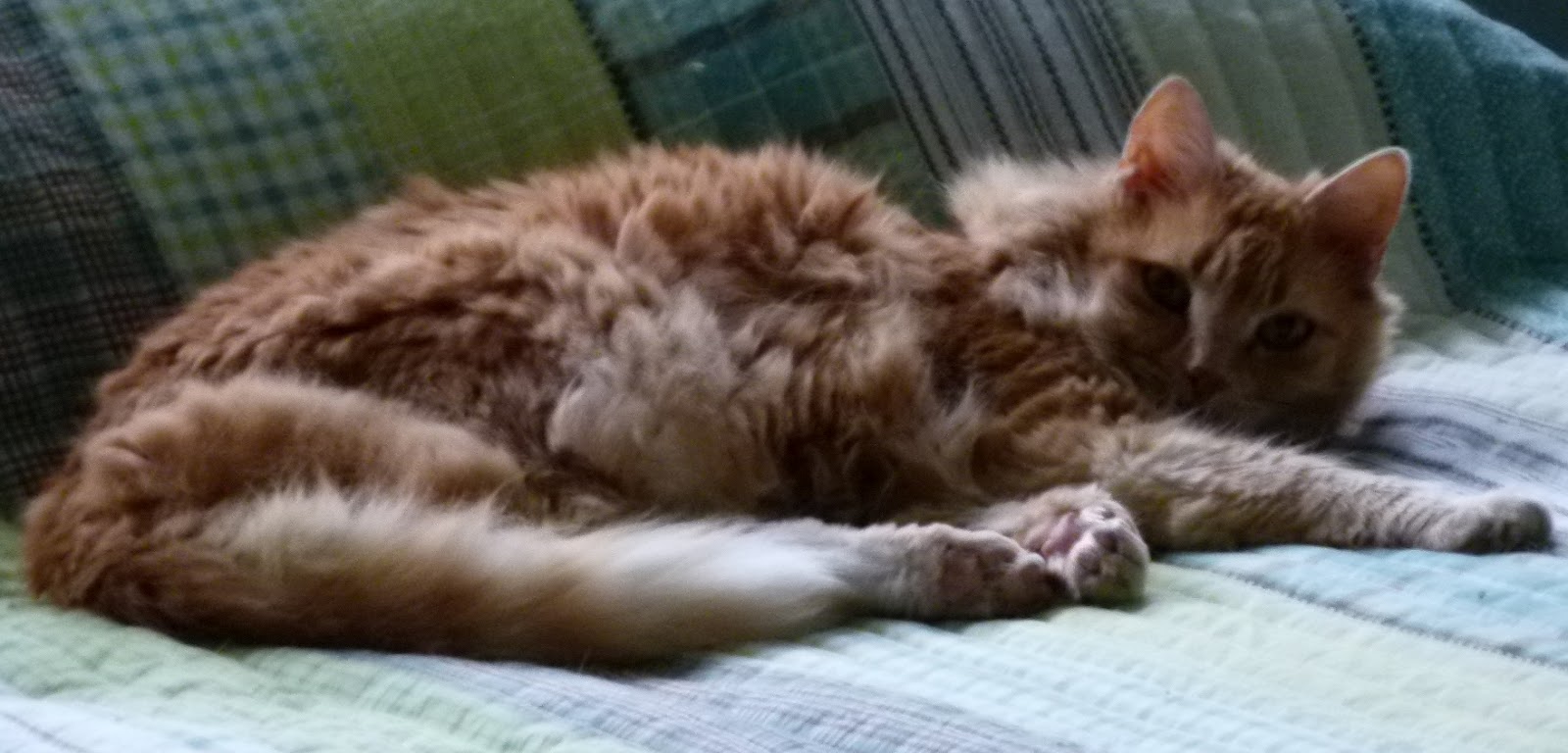
My old cat Rupert, aka Rupee, Godfrey (strangely), and Pest has permanently, like Elvis, "left the building". Only a cat with a personality as big as his deserves to be equated with a legendary entertainment icon. Rupert departed from this world today with infinite grace by a gentle hand, embraced by love. His health had declined significantly over the past few weeks as his old body gave out due to kidney failure. He was just shy of his 21st birthday.


All losses are sad and while the departure of this long-time friend and companion has brought its share of tears, I'm choosing to remember his lengthy, lively and always entertaining life. I introduced him to readers back in 2012 in Rascally Rupert: A cat like no other and he continued to be a dominant presence in my household. He bonded tightly with his cat "brother" Archie (The cat who could fly), and even as a very senior cat he coped well with the arrival of the kitten-and-puppy duo Hugo and Lily (see In with the new, The Great Distraction and And so...they grow!). He made it his mission to teach both youngsters the house rules - rules he himself was aware of but rarely felt obliged to obey. He was phased by few things, not dogs, not people, not even the vacuum cleaner. Rupert saw many others come and go but he stayed for two decades - constant, sometimes irritating, always faithful - and if at all possible he'd be at my side or on my lap, usually purring loudly. He had a weakness for Digestive biscuits.

Rupert and Archie
Sleeping Rupert and bright-eyed Hugo

Rupert's nap interrupted by Lily

Rupert was seldom allowed in my studio. He was not one of those cats who would pose artfully or simply curl up and sleep. No way! He was always wanting to either explore or participate, neither of which were helpful. However, he inspired his share of artwork over the years.

One of them was this silk painting:


Orange Cat and Red Geraniums"

Prior to that, he featured in this collage:


This oil pastel drawing depicts a time when Rupert vied for the best spot on the couch with his two former housemates - cat "brother" Jasper and collie Riley (both now departed):

Three's Company

It was through Rupert I learned about the unique qualities of orange cats and his legacy will continue. Hugo, now almost two years old, will now take over the post of Head Feline, surpassing his older, much bigger "brother" Archie whose more reserved nature precludes that role.

Hugo at on his post

Archie thinking inside the box
 
Archie and Hugo
 
Rupert, you are greatly missed - Greeter of Guests, Climber of Ladders, Window Tapper Extraordinaire, Escape Artist, Champion Snuggler, and Number One Purr-er - and you will be remembered by all who met you. You had many fans.
 
The house is quiet without you.


Thursday, 7 January 2016

The quest

When I started writing this blog nearly four years ago, my very first post was about a marvellous day, a Most Amazing Day, a day during which I saw birds that never fail to take my breath away. I'm talking about owls. On that particular day, I saw not one of these elusive birds but three different species, and one of them in abundant numbers. You can read that story in my post Day of the Owls.

Recently I had on my mind an owl of a different sort: the diminutive saw-whet owl. I know they can be found at the Reifel Bird Sanctuary during the winter months so off I went, camera fully charged, on a Quest for Owls not unlike that day four years ago.

I won't keep you in suspense. I was not successful in finding the little owls. After all, it's generally not possible to make owls appear on cue and rare to see them on demand. After a couple of hours of tramping around the sanctuary, I gave up. However owls were still on my mind so I decided stop at Boundary Bay on my way home just in case this was another year when snowy owls find their way south and hang about the shore. Failing that, there was the possibility of spotting short-eared owls in the nearby fields. Nope, there wasn't an owl in sight. The only owl I saw in the entire day was this one:


But I did see some other marvellous things, like this night heron who apparently suffered from insomnia because instead of sleeping in preparation for a night of foraging, he (or she) was wide awake, doing some feather preening and watching me quite intently with flame-red eyes. Having seen these birds in more tropical places, I'm always amazed to observe them in this chilly place, their most northerly wintering ground.


And sometimes when that special thing we truly seek is nowhere to be found, we are moved to appreciate more ordinary things. Consider, for instance, this gorgeous towhee. A common sight but this was a particularly glorious specimen:


Or this plump, perky robin:


Or this exquisite little golden-crowned sparrow:


Or this magnificent wood duck, almost too exquisite to be real:


A coloured pencil drawing of mine of a wood duck.

And there are always the sandhill cranes. No trip to the Reifel Bird Sanctuary would be complete without a few photos of these elegant birds.

 
A silk painting of mine, dating back a
couple of years, of a sandhill crane.
(This painting now resides in Malta!)

The one photo opportunity I regrettably missed was of hundreds, perhaps thousands of widgeons flocking between Boundary Bay and an adjacent golf course. I have rarely seen so many birds of a feather flocking together. It was awe inspiring. I do, however, have a photo of this plucky widgeon at the bird sanctuary. Just imagine thousands of them - some flying, some feeding, all whistling companionably to one another. Truly a sight to behold.
 
 
So even though I didn't see what I set out to find, I came home satisfied with my day. Sometimes a quest can be about the unexpected gifts along the way rather than the actual object of one's desire.

There will be another day for owls.

Note: If you'd like to see a saw-whet owl photographed at the Reifel Bird Sanctuary click here. I think you'll immediately understand why I'd love to encounter one!

Wednesday, 25 November 2015

A tale of four horses

Every commissioned portrait I make is special, and I don't mean because of my artistic skill - far from it! I mean because of the subject. It's because each animal is a one-of-a-kind individual in their appearance, their personality, and their life story. It's also because each human-animal relationship is unique.

When I'm asked to create a portrait of an animal, I'm aware it's because there was something extra-powerful between that human and that animal. I try to come to know each animal as well as I can in the brief time we might meet or, if they've already left this world or simply live too far away, from what their owner can tell me about them. I also work to uncover the particular connection between the person and his or her beloved four-legged friend. It goes without saying that capturing the animal's likeness in a portrait is important. I would add that infusing it with personality is crucial. And when I'm able to tap into the bond between the animal and its human partner, I feel like I've really done my job. 

A pencil drawing I made when I was about 14.
Horses were my first love (see my past blog A History of Horses) so any time I can work on something involving horses, I'm pretty happy about it. Over the last while I've been working on a coloured pencil portrait of not one but four horses - a project to delight the soul of a horse-loving artist like me.

However, along with the joy of creating this new work of art, the project has presented some unique challenges. These four horses span their owner's entire history of horse ownership dating back to the 1970s. Each represents a different time in her life, a different place, a different riding style, a different discipline, a different role. Each horse spent years with her, up until its death with the exception of the most recent arrival who is still going strong. They are of three different breeds but all are chestnut in colour with white markings. Even the two that share the same lineage - quarterhorses - are quite dis-similar in many ways, one with a high-headed, inquisitive expression, the other with a more reserved look about him.

Because three of the horses are deceased I'm limited to available photos - not a significant problem except when considering the size relationship between four animals who never actually lived together and each of whom are different shades of chestnut. The subtleties of their colour differences are not captured well in photos, particularly old slightly-yellowed snapshots. Conversations and consultations with the owner plus her lovingly written descriptions of each horse, his/her personality, and their time together have filled in the gaps. When I asked her, "Why chestnuts?" she said she didn't really know - they found her. She also told me about what she learned from each horse, and is still learning from the last of the four who came into her life not all that long ago - things like patience and bravery. Her bond with each of these individuals was and is unique, shaped by her life and by what each of them brought to her.

And so I am working on this most enjoyable project, starting with this preliminary sketch where I worked out the scale and composition.


They are arranged so that the horse from the most distant past is on the left, progressing through to the most recent on the right. The still-living horse on the right looks away from the other three, signifying his difference from the others.

Below is a photo of the drawing in progress (not a great photo because I took it on the fly using my phone camera under less-than-ideal conditions). I'm never good at photographing my work in progress because I'm simply too caught up in the work to be mindful of stopping to take pictures. However, this one particular photo shows the drawing developing from the ghostly horse on the left, where I'm just starting to build the image, to the more developed horses across the drawing to the right. I'm left-handed, so I usually work from right to left.


Both I and the owner are satisfied with each horse's expression and posture, with the relationship in height between them, and with the overall composition. Now it's just a question of persevering and getting it all done, and done right.

Some time later (and I don't count the hours), the drawing is nearly there:


And, finally, a photo of the finished product, framed and ready to go home: