Showing posts with label tropical mockingbird. Show all posts

Wednesday, 11 December 2013

It's a tough life (not!)

For the past couple of weeks I've been fortunate to escape the chilly Canadian west coast winter (in fact I hear it's been downright COLD with below-normal temperatures of -10 C). I'm once again in the southern Caribbean, basking in the steamy, nearly-equatorial heat of Trinidad and taking in the breezy trade winds of neighbouring Grenada. Both islands are equally beautiful in their own right.


Maracas waterfall, Trinidad.
 
Sunset view from Grand Anse beach, Grenada
In this part of the world, with a fertile combination of volcanic soil, ample rain and no shortage of sunshine, lush plant life abounds, including exotic fruits and gorgeous flowers. 

Cocoa bean pods and the tiny flowers from which they form.

Orchids blooming among coconut husks.

Colourful bougainvillea gracing an old stone wall.
But it's the smaller things - the lively ones - that never fail to capture my attention. There are bright green lizards scaling walls...

 
... and bats hanging from the rafters of old buildings, napping in the noon-day heat...

 
... and turtles poking up their noses for a breath of tropical air.
 

And of course it's the birds that really captivate me. From noisy flocks of orange-winged Amazon parrots perched high in trees just outside my apartment window in Trinidad...


  ...to drunken hummingbirds sipping carambola (star fruit) nectar...

 
...to cheeky bananaquits squabbling among the foliage just about everywhere I go. They're as common as sparrows or chickadees back home.

A typical bananaquit with bright yellow breast feathers.
A more unusual jet-black bananaquit, found in Grenada and also neighbouring St. Vincent. 
Among my favourites are the tropical mockingbirds whose warbling song awakens me each morning:


My blog readers will remember that last winter I captured the image of a mockingbird in an urban Trinidad setting in this drawing "Song of the Tropics: Mockingbird".


To my delight, just next door to my apartment in Grenada there's a resident juvenile Yellow Crowned Night Heron who defies his (or her) name and can be seen most mornings hunting for small crabs. He/she is not at all shy about posing for my camera:

 
One thrilling morning I was able to observe a handsome adult on the same quest for a crab breakfast.
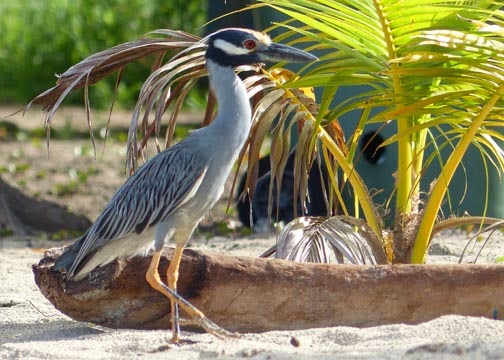
 
 
It's hard to imagine that the night herons' range on the Pacific coast of North America extends from the tropics as far north as British Columbia. The Reifel Bird Sanctuary plays host to a handful of Black Crowned Night Herons each fall/winter, although this one that I observed last year appears to be longing for more balmy temperatures while huddled among cold, bare branches:
 
 
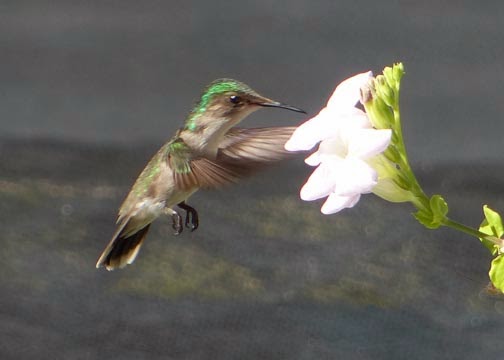
Below my balcony hummingbirds make regular visits to some pretty pink flowers that grow on a latticed arbour, waging territorial wars with the bananaquits and bees who compete for the flowers' nectar.
 
 
While I haven't yet used my time here to make any art, inspiration is everywhere! And although I may not have done much art making over the past couple of weeks, it's never far from my thoughts.

I recently listened to an interview with portrait artist Phil Richards (he was commissioned by the government of Canada to paint a portrait of Queen Elizabeth II) speaking about his life as an artist and his artistic process. I can't remember his exact words, but the gist of something he said truly resonated with me: he described being an artist as being an observer of the world rather than an active participant; that artists always have a certain detachment as we continually contemplate how to depict our vision the world around us on our canvas, or sketchbook, or whatever our chosen medium may be. We're on the outside looking in, so to speak.

Even though I'm here in this lush, gorgeous part of the world, feeling the warmth of the sun on my skin and the grit of sand between my toes as cool blue waves lap at my ankles, lulled by the rhythm of the surf, the warbling of mockingbirds, and perhaps the notes of lively human music drifting in from a distance, my mind is often completely absorbed by the interplay of colour, light and form. I'm captivated by the antics of seabirds diving for fish, lizards scampering among the undergrowth, or beach dogs dozing in the shade. I can get completely caught up observing something as ordinary as a preening pigeon perched on a telephone wire while others in my party enjoy drinks and lunch in a local waterfront bar.


On an ongoing basis, potential compositions are mentally constructed, reframed, edited and assessed; some are found wanting and are discarded but the sound ideas are filed away for future reference. And sometimes some scrawled notes and a quick sketch, backed up by a string of photos, ensure the idea remains solid.

I don't feel that being an observer of the world means the experiences life has to offer are any less rich, or enjoyable, or that I don't fully appreciate them. However, it does mean that I'm always, always, always "working".

Such is my life as an artist - and a lucky one, at that!

Tuesday, 29 January 2013

Unforgettable faces

In just a few days I'll be winging my way northward to Canada from my winter haven in the Caribbean - a migration slightly too early for spring but that welcome season should be just around the corner when I get back home to southwestern British Columbia. I've been pondering how to close this chapter in my life as an artist, and started looking for ideas through the photos I've taken during my travels around Trinidad, Guyana, Grenada and, most recently, Tobago. As I've mentioned before, my camera is an invaluable tool in my art practice so I'm continually clicking away at any bird, bug or other critter that happens to cross my path. From the vast (and I do mean VAST) number of photos I've taken, here is a selection of faces I've recorded - furred, feathered and otherwise.
 
There were some great twosomes, like this father dog his "mini-me" pup I observed at Mount Saint Benedict, Trinidad:

 
It looked to all the world like the senior dog was showing the youngster the ropes, as any devoted dad would, and the little pup was avidly watching his father's every move.
 
Then there were these two companionable doves who appear to be caught up practising some dance moves:
 

In Grenada I observed this solitary tern who rejected perching with his flock on their favourite fishing boat, preferring instead a neighbouring boat and the company of a small shorebird:
 
 
Of course there were some wonderful feathered faces, like this captive blue and gold macaw in who I photographed enjoying its lunch in Trinidad.


My enjoyment of tame birds like this one has been forever altered by seeing them in the wilds of Guyana. A long life in solitary captivity (they live an average of 50 years and mate for life) seems like a poor substitute for an athletic, social bird who was meant to be soaring free above the vast rainforest canopy. However, these birds were hunted to extinction in Trinidad some decades ago, and a small population has recently been re-established in the protected Nariva Swamp area through the release of captive-bred birds. For the sake of species preservation it seems that captivity for some individuals is a necessary evil.

"Treasure of Nariva" (silk painting)
Another bird I photographed in Trinidad enjoying a snack was this palm tanager who was munching on some sort of fruit:
 
 
Tanagers are very common in this part of the world and come in some stunning varieties, such as the lovely blue-grey species. I observed this one perched on a gutter:
 
 
I have also photographed songbirds who may not be the most interesting to look at but who make up for it with their striking vocalizations, like this wren:
 
 
And like this chachalaca (locally called a cocrico) I spotted in Tobago's Grafton Bird Sanctuary.
 
 
They're a boring-looking brown, chicken-like birds but their loud, exotic squawks and hoots are like something from the soundtrack of a 1930s Tarzan movie.
 
Everywhere I travelled, tropical mockingbirds could be heard warbling their melodic songs: 

These mockingbirds are a species that appear to have adapted well to urban life. I recently completed a coloured pencil drawing of a tropical mockingbird posed in front of a weathered sign near my apartment in Trinidad.

"Song of the Tropics:
Mockingbird" (coloured pencil)
I intended the image to depict the concept of the urban jungle - a melding of wild and human habitat where wildlife has made necessary adaptations in order to survive, but how the toll of natural forces gradually erodes human structures and reclaims the land, perhaps one day giving it back to the wild creatures.
 
On a less serious note, this jaunty Muscovy duck had a twinkle in its eye, maybe because it was living in a sanctuary and therefore not destined for the dinner table:
 
 
I photographed this wee hummingbird stretching its wings while sticking its tongue out!
 
 
One of the strangest birds I encountered was this boat-billed heron in Guyana (it's a night fisher who roosts in the forest by day):
 
 
And then there was this weird looking bare-eyed thrush - so named for the rings of wrinkly yellow skin that surround its eyes (I saw this one in Tobago):
 
 
Another leathery-faced bird I encountered - a brown pelican - appeared as though it would rather be napping than keeping an eye on me.
 
 
One of the most striking creatures I saw in my travels is this green anaconda:
 
 
Eighteen feet long, 32" in circumference, and weighing over 200 pounds, it was captured just weeks ago beside a roadway a few miles from my apartment in Trinidad. Now in the custody of the zoological society, the snake is resting under observation and veterinary care while humans determine its future. While wild release would be preferable no decision has yet been made public.
 
Another Goliath I observed was this massive grasshopper-like insect that was easily 8" long from head to tail.
 
It was comfortably perched on a dining room chair at the lodge where I stayed in Guyana and posed quite nicely for me.
 
Of slightly lesser stature is this fat toad who came to sit below an outdoor faucet at my apartment in Trinidad:
 
 
Locally called a crapaud (pronounced in Trinidad as "crap-o"), these plump amphibians are relatively common, likely because they secrete poisonous mucus through their skin if they feel threatened. This one appeared to be thriving.
 
I have seen and photographed so many interesting creatures that its difficult to select just a few, but this turtle is one of them:
 

Not particularly large or remarkable, but what a face! And he/she posed so nicely for me.
 
I'll close with this image of a kiskadee flycatcher:
 
 
About the size of a jay, they're named for their raucous, repetitive "kiss-ka-dee" call - I can hear them outside my window as I write this. I captured this particular photograph in Guyana but I've seen these birds everywhere I've travelled. They are not at all shy and can be seen perched on telephone lines, tree branches, fenceposts - you name it - and at virtually any hour of the day. They are, for me, an emblem of my winter stay in this tropical part of the world. Just one of the many unforgettable faces I've encountered during my winter sojourn in the southern Caribbean.